Empower IoT terminal devices to achieve "power freedom"
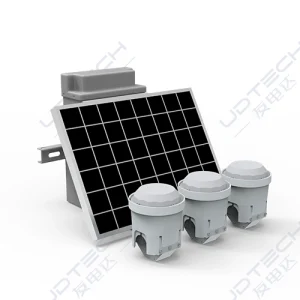
We provide core components and auxiliary parts to ensure the perfect matching from key components to peripheral auxiliary materials, and safeguard the long-term and stable operation of your project.
Common questions
How is the device powered? How long is the battery life?
It adopts a combined power supply of solar energy, CT power extraction, and high - performance batteries, and can still operate for more than 30 days under continuous rainy conditions.
Does it support customized development?
Support function customization (such as adding sensors, adjusting communication methods), software requirement customization, and data protocol adaptation. Specific requirements can be coordinated with the technical team.
How is the monitoring data transmitted?
Transmitted to the cloud platform via 4G/NB-IoT wireless network, and the data update frequency can be customized (such as 5 minutes to 1 hour).
Can the equipment work properly in bad weather?
The device has an IP66 protection level, a working temperature range of -40℃ to +85℃, and is designed with lightning protection and anti-corrosion features. It can operate stably in environments such as rain, snow, and strong winds.

Can the two devices be integrated into one?
The dancing, sag, icing and meteorological multi-functional monitoring device can be customized according to requirements, reducing the installation points and cost.
What are the practical functions of galloping and sag monitoring?
1. Dancing data can be used to analyze wind damage risks and guide the design of anti-dancing devices or the renovation of lines.
2. Sag data can be used to judge the temperature change of the conductor and the load - bearing situation, and avoid discharge caused by insufficient ground clearance.
What is the principle of icing monitoring?
1. Comprehensively monitor the equivalent ice thickness through multi - dimensional sensors. The core basis is:
2. Calculate the ice load based on the changes in wire inclination and tension;
3. Auxiliary calibration of meteorological parameters (temperature, humidity, wind speed)
4. Image recognition verification of ice-covering forms can be optionally configured.
How accurate is the measurement of ice thickness?
Under standard conditions, the accuracy of equivalent ice thickness can reach ±2mm. At the same time, original data such as tension and inclination angle are provided for professional analysis.
Contact Us
Sales Information WeChat
Project information WeChat