

Geological disaster monitoring

The solar power supply system provides round-the-clock power support for disaster monitoring terminals, sensors, cameras, communication modules and other devices through efficient photoelectric conversion and intelligent energy storage management.

Application background

The solar power supply system plays a crucial role in natural environmental disaster monitoring. It provides stable, reliable, and continuous clean energy for various disaster monitoring devices in areas without grid power, ensuring the uninterrupted collection and transmission of disaster warning and monitoring data, and effectively enhancing the ability to prevent and mitigate disasters.

With the frequent occurrence of natural disasters and the increasingly urgent need for prevention and control, real-time and continuous monitoring of disasters such as landslides, debris flows, floods, and earthquakes has become crucial. Traditional monitoring stations rely on mains electricity or battery power, which have obvious shortcomings in disaster-prone and remote areas:

  • Hidden danger points are located in remote areas:Geological disaster - prone areas are mostly located in areas such as mountains, slopes, and river channels, where the municipal power supply is difficult to cover.

  • The monitoring network is widely dispersed:In order to comprehensively capture disaster signals, monitoring points often need to be deployed over a wide range and in a distributed manner, which makes wiring difficult.

  • Emergency monitoring response:Communication and monitoring equipment at the post-disaster site need to be rapidly set up and operate autonomously.

  • Long - term unattended:Monitoring points are often in harsh environments, requiring the system to operate stably for a long time and reduce the frequency of maintenance.

The solar power supply system provides round-the-clock power support for disaster monitoring terminals, sensors, cameras, communication modules and other devices through efficient photoelectric conversion and intelligent energy storage management.

system architecture

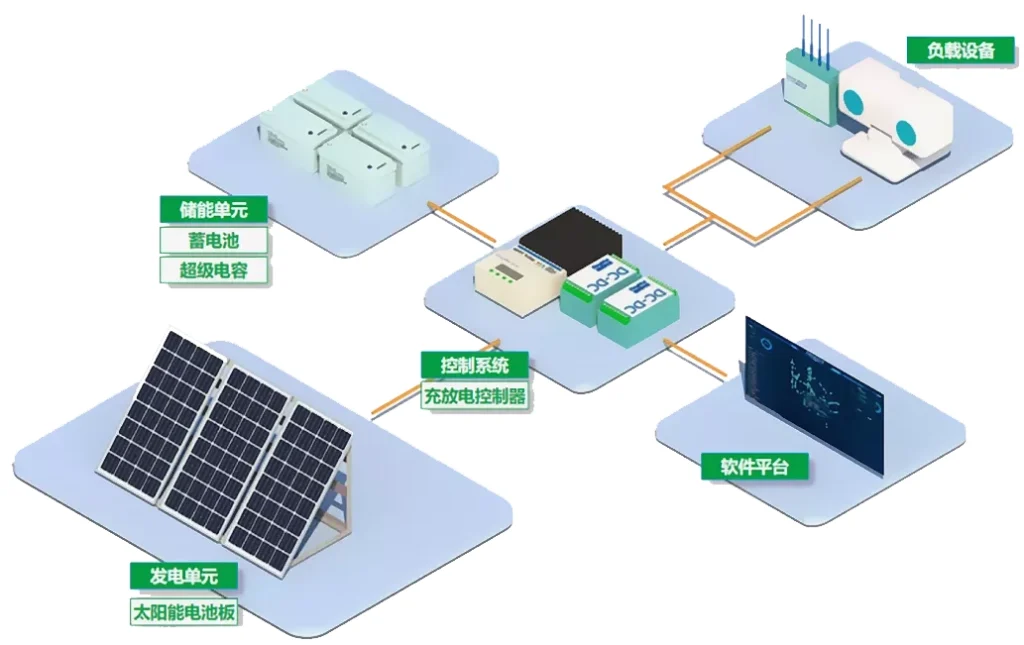
This solar - powered monitoring system adopts an integrated intelligent architecture, using solar energy as the sole energy source. Through the collaborative work of four core modules, it ensures that the monitoring equipment can operate continuously all year round in an environment without mains power.

Advantages of solar power supply solutions

This article deeply analyzes the core pain points of the traditional hydrological monitoring mode in terms of human reliance, data blind spots, and response delays. It systematically expounds on how the solar-powered IoT monitoring system achieves unmanned intelligent monitoring of the entire basin, all elements, and around the clock

Application cases

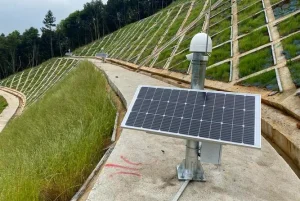
Build an intelligent slope safety defense line for rail transit

In the criss - cross railway and urban rail transit networks in our country, tens of thousands of slopes, like silent guardians, maintain the safety and smooth operation of the rail lines. However, under the long - term effects of natural weathering, rainwater erosion, train vibrations, and extreme weather, these slopes may deform, slide, or even collapse, seriously threatening the safety of train operations.
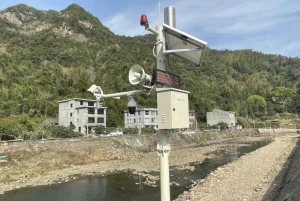
How does the solar-powered IoT monitoring system install an "early warning radar" for small watersheds?

Mountain torrents are characterized by sudden onset, rapid disaster formation, and great destructive power, and are the main natural disasters in mountainous areas. This article focuses on the "last mile" problem of small - watershed mountain torrent early warning, and details how the solar - powered IoT monitoring system can break through the monitoring bottleneck in areas without electricity and network through ......
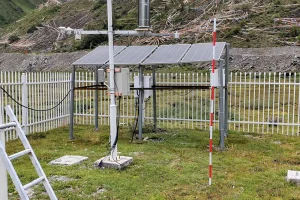
The solar - powered IoT monitoring system enables accurate early warning of alpine avalanches

Avalanches, known as the "white death", are a worldwide challenge to predict. This article focuses on the extreme environmental challenges of alpine avalanche early warning and elaborates on how the solar-powered Internet of Things monitoring system can deploy a multi-parameter sensor network that is resistant to extreme cold and self-powered to monitor the key physical indicators of the snowpack in real time......

Scroll to Top